Recovery is built on more than willpower. See what you have, and build what you need.
Developing Your Recovery Capital: a hands-on workbook to understand your values, spot your triggers, and put a plan in place.
- 51 pages with typeable fields, plus an interactive online version
- 8 modules plus 5 self-assessments with automatic scoring in the online version
- Includes a discussion guide for groups and peer sessions
$20 one-time payment
No subscription · Instant access after checkout
51
pages to fill in
5
scored self-assessments
1
personal recovery plan
2
formats: PDF + online
Know your strengths. Fill the gaps.
Recovery capital is the sum of the personal, social, community and cultural resources you can draw on to start and sustain recovery. This workbook helps you take stock of what you already have, find the gaps, and write a plan to build more, at your own pace.
People in recovery
From substance use or mental health challenges, at any stage of the journey.
Peer specialists & counselors
A ready-made workbook and discussion guide to use with clients or groups.
Anyone building a plan
If you want a clear, realistic wellness plan for the long term, start here.
What’s inside
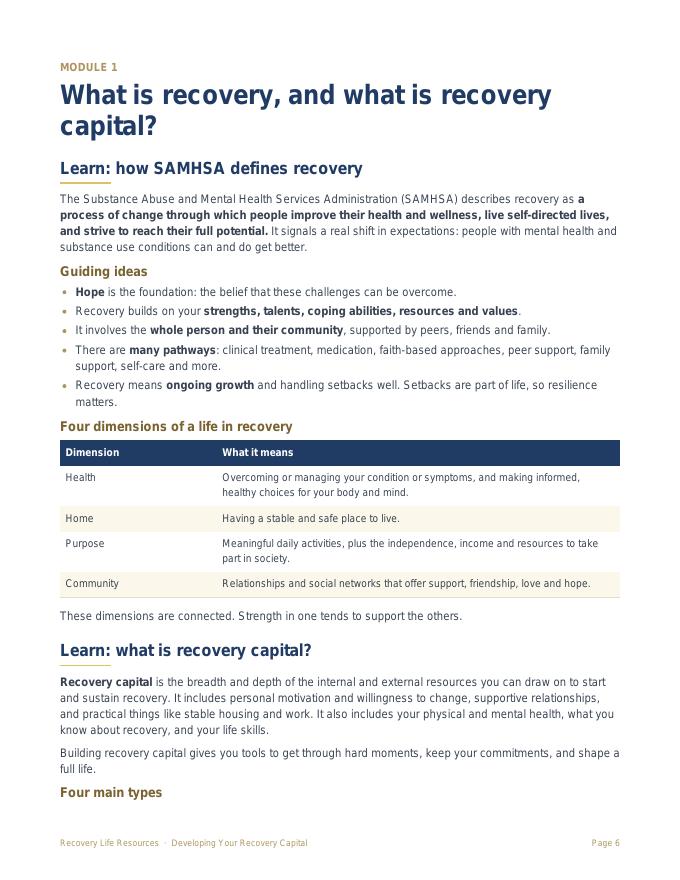
What is recovery capital?
SAMHSA’s definition of recovery, the four dimensions of a life in recovery, and a self-check of what you already have.
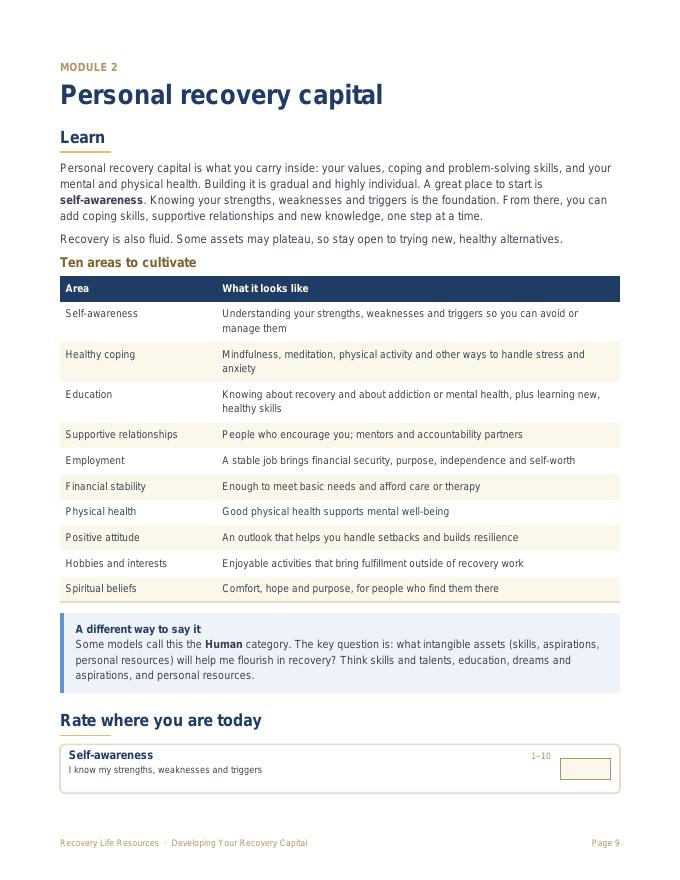
Personal capital
Ten areas to build, from self-awareness and coping skills to health, work and hobbies, plus a building worksheet.
Social capital
Map who supports you, find groups that fit, and plan small steps to add healthy connection.
Community capital
Housing, food, health care, job training and recovery supports in your area, and how to reach them.
Cultural capital
Traditions, faith, identity and mentors that give you roots and belonging.
Evidence & levels
What the research says about recovery capital, why it ebbs and flows, and how levels shape the support a person needs.
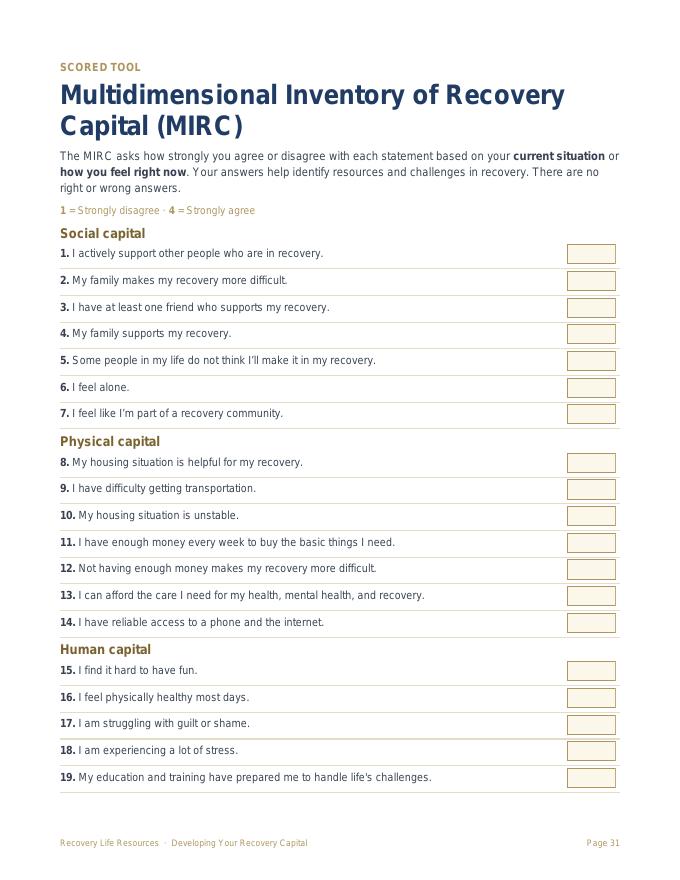
Measuring recovery capital
How the BARC-10, MIRC and RCI look at recovery capital, plus five ready-to-use self-assessments: the 0–10 self-inventory, BARC-10, MIRC, the Recovery Capital Questionnaire and the Mental Health and Recovery Capital Action Plan.
Treatment & aftercare
How to bring recovery capital into a treatment or aftercare plan, with questions for your care team and a treatment plan worksheet.
Bonus pages
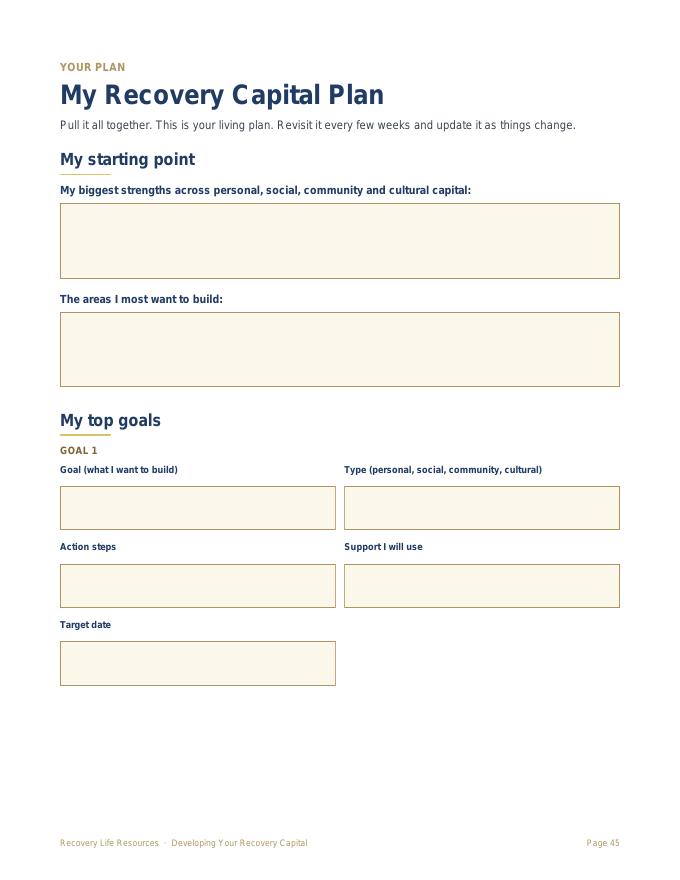
A starting snapshot, scored self-assessments, a treatment plan worksheet, a myth-or-fact knowledge check, your personal Recovery Capital Plan, a one-page quick reference, a glossary and a group discussion guide.
A look inside
Clear pages with room to write. Every cream-colored box is a fillable field. Swipe to see more →
What you get for $20
The fillable PDF
51 pages. Type right into it, or print it and write by hand. Keep it forever.
The interactive online version
Works on any phone, tablet or computer. Your answers save as you go, and you can download a copy.
Right after you pay, you’ll be taken to your download page. The files are not sent by email, so please bookmark that page or save the files before you close it.
What participants say about our workshops
“These workshops really opened my eyes to the fact that I needed support on my recovery journey and that I get to choose exactly what that looks like. Building your recovery capital does not have to be complicated it just requires that you seek to leverage other people and resources that can help you to create and sustain a better life for yourself.”
Warren County, NJ resident, person in long-term recovery
“I had been misusing alcohol and substances for many years and I finally found a platform and people who truly care about me and my personal preferences. The workshop content is thorough and has inspired me to make important changes that are critical to my long-term recovery.”
Sussex County, NJ resident
Questions
Is this therapy or treatment?+
No. It is peer-support education from Recovery Life Resources. It complements, and does not replace, care from a licensed professional. You are welcome to share your finished plan with your counselor or therapist. If you’re in crisis, call or text 988, or call the SAMHSA National Helpline at 1-800-662-4357.
What format is it?+
You get a 51-page PDF with typeable fields (you can also print it) and an interactive online version that works in any phone, tablet or computer browser.
How do I get the workbook after I pay?+
Immediately after checkout you’re taken to a download page with the fillable PDF and a link to the online workbook. The files are not emailed to you, so please bookmark that page.
Can I fill it in on my phone?+
Yes. The online version is built for phones. For the PDF on a phone or tablet, open it in the free Adobe Acrobat Reader app so every box is typeable.
Where are my answers saved?+
In the online version, your answers save automatically in your own browser on that device. They aren’t sent to anyone. You can download a copy at any time.
Can I use it with a group or clients?+
Yes. A discussion guide for peer specialists, counselors and group leaders is included at the back.
Are there ongoing charges?+
No. It’s a one-time payment and you keep the workbook.

Recovery Life Resources
Recovery Life Resources is a New Jersey 501(c)(3) nonprofit offering person-centered addiction and mental-health recovery support to individuals, families and provider partners across New Jersey and Eastern Pennsylvania. Our values: Hope, Humility, Mutuality, Collaboration.
Questions? Call 914-400-8108 or visit recoveryliferesources.org.